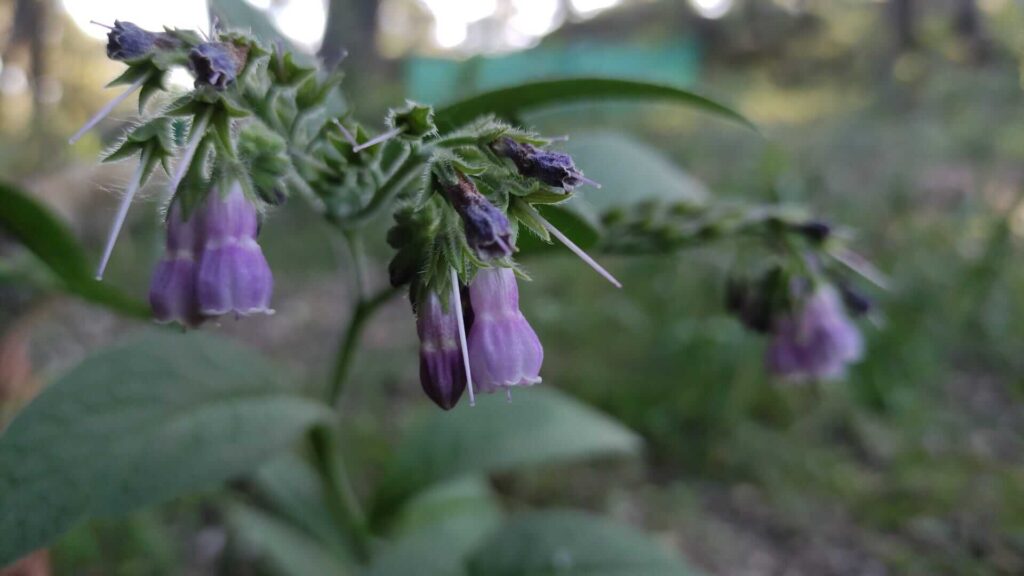
Russian Comfrey, scientifically known as Symphytum x Uplandicum, is an essential herbaceous plant for any vegetable garden. Its most significant property is its very deep root system, which allows it to bring up hard-to-reach nutrients, primarily Phosphorus, to the surface.

Needs constant moisture, especially in summer

Prefers a semi-shaded spot, ideally under the shade of a tree

Exudation Hose / Drip Irrigation

Easy to cultivate

Withstands intense frosts

By root division
Russian Comfrey Care
Soil Requirements
Russian Comfrey adapts to various soil types, but fertile soils are ideal for it. It’s important to consider that since we want to extract deeply stored nutrients, the comfrey must be able to reach them, so it should be planted in deep soil. Its roots can extend up to 3 meters deep.
Soil Preparation
It doesn’t require any special preparation. Obviously, comfrey should never be grown in a pot.
Light Requirements
It needs to be in a semi-shaded area, with a short period of sun exposure. It doesn’t tolerate prolonged direct sun, especially during the hottest hours.
Watering
Comfrey requires regular watering, especially during dry periods. The soil should have constant moisture. It tolerates short periods of flooding well; its roots are resistant to rot from excess moisture.
Watering Methods
Drip irrigation or, even better, an exudation hose, are the best options for Russian Comfrey.
Seedling Care
Pest Protection
Russian Comfrey is quite resistant to pests and diseases, but it can be susceptible to aphids and fungi such as powdery mildew and rust.
Comfrey in Winter
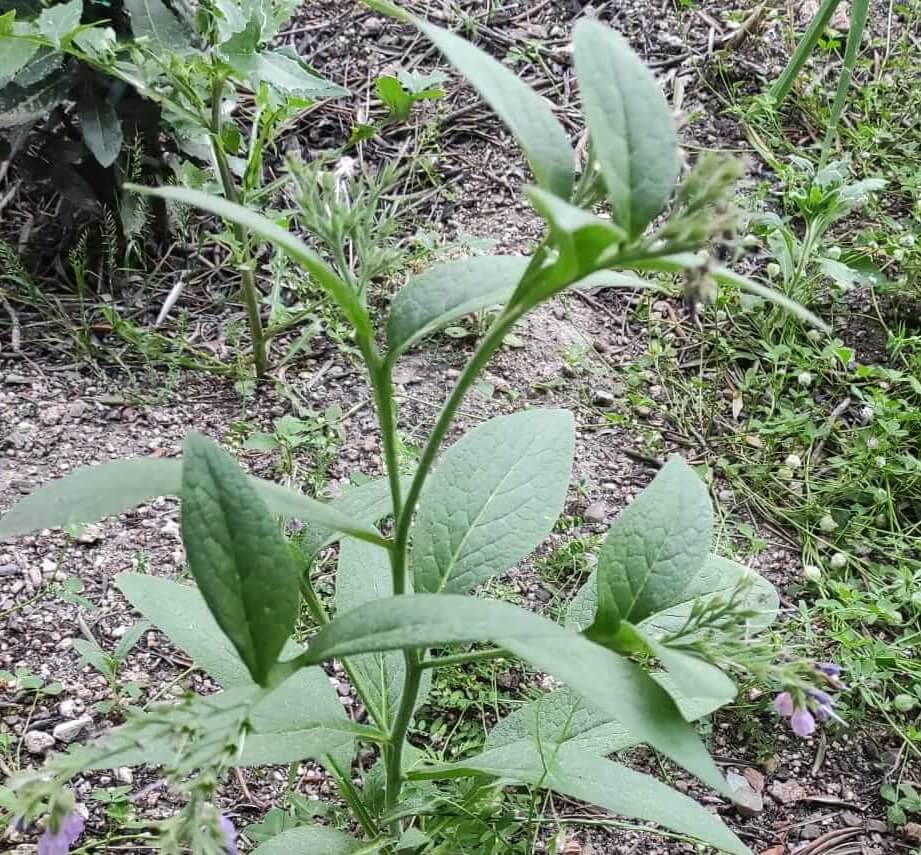
In areas with winter frosts, the plant will lose its leaves but remain alive in its root system, sprouting again in spring.
If frosts are very intense and the planting area doesn’t receive sun in winter, mulching can help. If it does receive sun, it’s better not to mulch so that the rays can warm the soil.
How to Propagate Russian Comfrey
Propagation by Division
Russian Comfrey is a hybrid plant, similar to what a mule would be in the animal world. It is a sterile plant, so its seeds are not fertile. Therefore, we can only propagate it by dividing its roots.
This process should be done in spring or autumn, keeping in mind that when dividing, each fragment must have roots and buds, a minimum of 5 centimeters, for the plant to thrive.
Uses of Russian Comfrey
Medicinal Uses
It has healing properties for wounds. It should be used with caution as it contains alkaloids toxic to the liver. We do not use it as a medicinal plant.
Uses for the Garden
This is undoubtedly the use we will give to Russian Comfrey. As we mentioned earlier, its deep root system brings up nutrients that tend to leach into deeper layers with irrigation or rain. Primarily, we’ll be looking to obtain Phosphorus, one of the three NPK nutrients, and the most difficult to acquire through natural means. This is why we’ll want to have Russian Comfrey.
Obtaining its Nutrients
It’s advisable to use the plant as little as possible in its first year to allow it to develop, meaning don’t prune it too much.
Its nutrients can be obtained in 3 complementary ways:
– By making comfrey slurry or tea.
– Directly mulching with its leaves in the garden bed (provided they are disease-free).
– Adding them to compost. If we know or suspect the plant has a disease, this will be the best method if we make hot compost.
Now that you know Russian comfrey, here are some recommendations that we think might be useful to you:
🌿 Russian Comfrey Seeds
Cultivate this versatile plant and discover how to harness its many uses.
💧 Exudation Textile Tape
Ideal for localized irrigation and water saving in vegetable gardens and regular gardens.