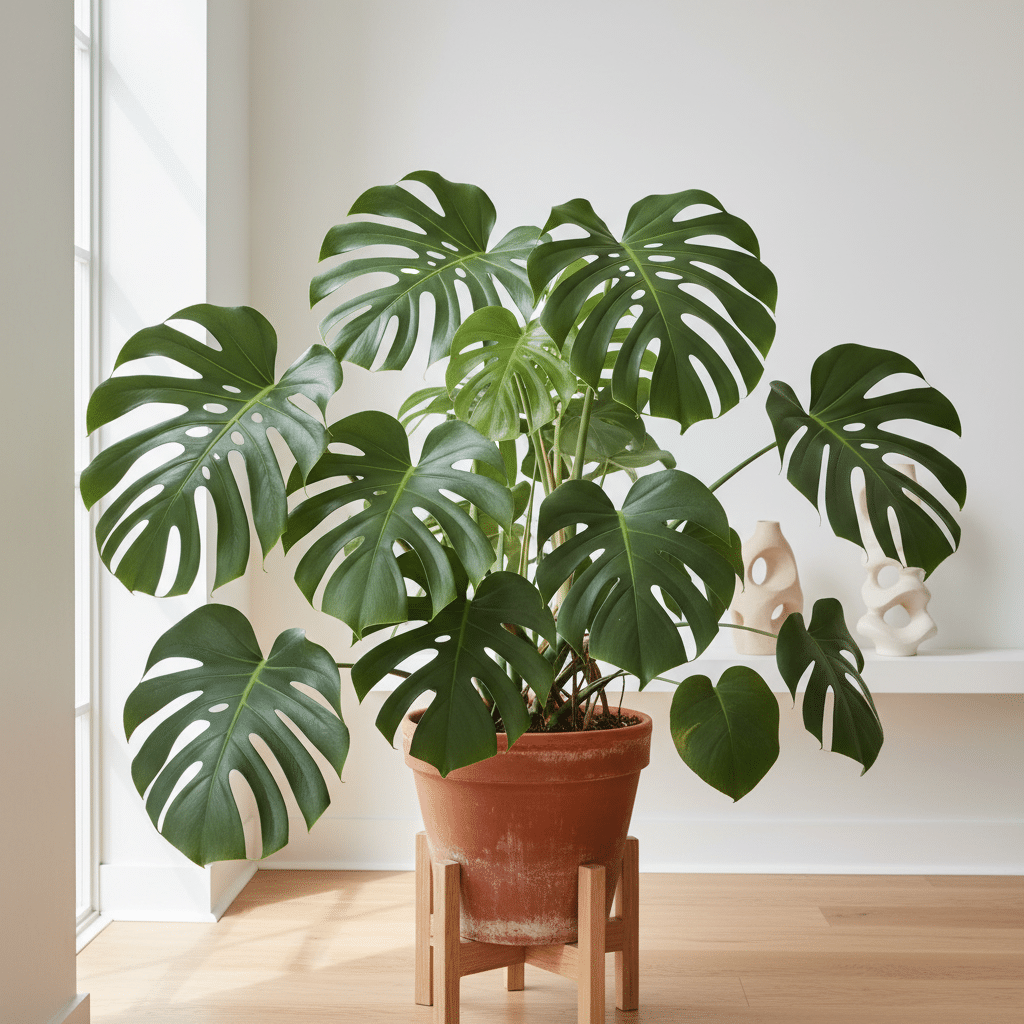
Monstera deliciosa is probably the most photographed houseplant of the last decade. Its large, characteristically split leaves have taken over magazines, social media and countless living rooms. But beyond its looks, it’s a plant with a lot going for it: sturdy, fast-growing, and remarkably tolerant of indoor living conditions.
Origin and botanical curiosities
Native to the humid tropical forests of Mexico and Central America, Monstera deliciosa is a climber that in its natural habitat can reach over 20 meters (65 feet), clinging to trees with its aerial roots. The name deliciosa refers to its fruit, edible when fully ripe and with a flavor reminiscent of tropical pineapple. The holes in adult leaves (fenestrations) are an adaptation to withstand strong winds and let light reach the lower foliage.
Light
It needs bright, indirect light. Leaves exposed to direct midday sun scorch easily. The sweet spot is 1-2 meters from an east- or west-facing window, or a bit farther back from a south-facing window filtered by sheer curtains. In low light it will grow more slowly and new leaves will have fewer holes or stay completely solid — fenestration is a luxury the plant saves for when it has energy to spare.

Watering
The most common mistake with Monstera is overwatering. Roots rot quickly in waterlogged soil. The practical rule: water when the top 5 cm (2 inches) of the substrate are dry. In summer that can mean watering every 7-10 days; in winter it may be every 3 weeks. Use room-temperature water and let it drain freely through the pot’s holes.
Soil and pot
A free-draining substrate is essential. Mix all-purpose potting soil with perlite (20-30%) and, if you have some, small chunks of orchid bark. This airy texture lets the roots breathe and prevents waterlogging. The pot must have drainage holes, no exceptions. Don’t rush to repot: Monstera flowers better when slightly snug in its container.
Humidity and temperature
It’s a tropical plant, so it appreciates ambient humidity above 50%. In dry interiors (especially in winter with the heating on), mist the leaves or set the pot on a tray of pebbles and water, without the pot touching the water. Ideal temperatures sit between 18 and 30°C (65-86°F); below 12°C (54°F) growth stalls.
Fertilizing
In spring and summer, feed with a balanced liquid fertilizer every 2-4 weeks. In fall and winter, cut back or stop altogether. A telltale sign the plant needs nutrients is new leaves coming in small or pale.
Propagation
Propagating from cuttings is very straightforward. Cut a stem with at least one node and one aerial root. You can root it in water (visible and fun to watch) or straight into moist perlite (faster and less stressful for the plant). If you use the water method, change the water every 3-4 days, and don’t move it to soil until the roots are longer than 5 cm.
Aerial roots: what should I do with them?
Many Monstera owners wonder what to do with the aerial roots sprouting from the stem. The most beneficial thing for the plant is to guide them toward the substrate or into a moist moss pole; that way they absorb extra water and nutrients. Avoid cutting them if you can.