If you have a garden, you’ll know that one of the most important, and sometimes most complex, topics is irrigation. And if you’re also looking for a sustainable way to keep your plants healthy and save water while growing, choosing the right irrigation system becomes even more crucial.
For all these reasons, today we’re explaining two methods widely used in organic farming: drip irrigation and soaker hose irrigation. Stay with us and let’s explore what they are, how they differ, and which one is best for your garden.
Irrigation Systems: Drip or Soaker Hose
Both methods, drip irrigation and soaker hose irrigation, have the main goal of delivering water directly to plant roots in a controlled manner, reducing waste and promoting more sustainable agriculture. However, each works differently, making them more or less suitable depending on the type of crop, terrain, or your personal preferences.
Below, let’s look at how each system works, its advantages, limitations, and important considerations:
Drip Irrigation
Drip irrigation is a system that delivers water directly to the base of each plant through pipes with small integrated drippers. These drippers can be fixed flow (always releasing the same amount of water) or adjustable, which allows us to adapt irrigation to the needs of each type of plant.
This method is especially useful in various types of cultivation setups such as:
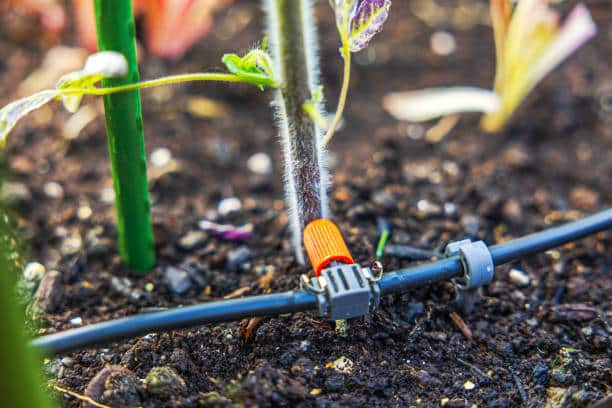
- Varied crops. It allows you to adjust the flow rate of each dripper individually, so that each plant receives only the amount it needs.
- Row crops. It allows placing a dripper right at the base of each plant, avoiding wetting unnecessary areas of the soil and maximizing water efficiency.
- Gardens with pots or planters. It allows connecting several drippers with a single tube, distributing water precisely without having to water each one by hand.
One of the main advantages of this irrigation system is that water is used very efficiently. It only waters the root zone, minimizing evaporation and preventing weeds from growing between plants. Furthermore, we can easily automate it with a timer and thus forget about manual watering.
It also helps prevent plant diseases. By watering directly at the root, it avoids excess moisture on the soil surface or on the leaves, which reduces the incidence of fungi, rot, or bacteria that thrive in poorly managed humid environments.
Soaker Hose Irrigation
Soaker hose irrigation, also known as exudation irrigation or porous hose irrigation, works differently: instead of having drippers, the entire hose “sweats” water. This means water is slowly released along the entire surface of the tube, creating a continuous band of moisture in the soil.
This system is especially effective when seeking to maintain constant and uniform moisture over a wider surface, such as in:
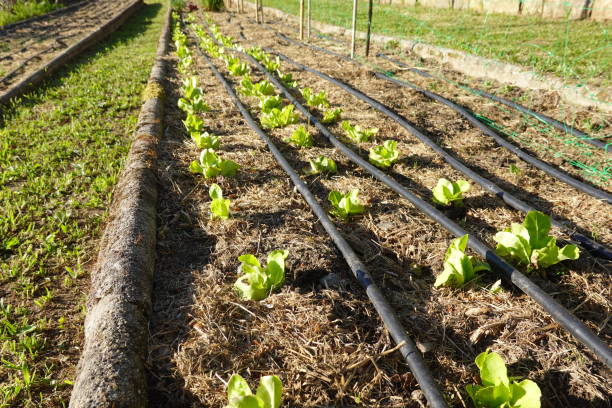
- Raised beds with dense crops. It allows the entire area to be hydrated homogeneously. Unlike drip irrigation, the soaker hose releases moisture along its entire surface, continuously soaking the soil and promoting more balanced root development.
- Light or sandy soils. It provides constant and slow hydration, allowing the soil to retain moisture better and reducing water stress in plants.
It’s a very simple system to install, especially on straight terrain or without many obstacles. However, it does not allow you to adjust the flow rate plant by plant, so it may not be the best option if you have very varied crops.
Additionally, with this system, it’s important to monitor excessive water accumulation, as if the system is left running for too long or if the soil doesn’t drain well, waterlogged areas can be created that favor the growth of fungi, mold, and even the development of root diseases.
Therefore, although soaker hose irrigation provides uniformity, it requires careful planning of watering time and frequency.
Comparison Chart
| Drip Irrigation | Soaker Hose Irrigation | |
| Water Distribution | Targeted, right at the base of each crop | Continuous, along the entire hose |
| Flow Control | Adjustable per crop | Non-adjustable; same flow rate along the entire line |
| Installation | Requires more planning | Easier on flat and uniform surfaces |
| Ideal For | Pots, rows, various crops… | Raised beds, dense or fast-growing crops |
| Automation | Very simple with a timer | Also possible, though less precise |
| Maintenance | Drippers and filters must be cleaned periodically | Accumulation of lime or sediment must be avoided |
Which System Saves More Water in the Long Run?
When we talk about water efficiency in the garden, both drip irrigation and soaker hose irrigation represent a significant advancement over more traditional methods like hose watering or sprinkler irrigation. However, if you’re looking to minimize water consumption as much as possible in the long run, there are some key differences to consider.
Under optimal conditions, soaker hose irrigation is the system that saves the most water in the long run. Its main advantage is that:
- It operates at very low pressure, which reduces energy consumption associated with pumps or mains pressure.
- It releases water very slowly and constantly through a porous hose.
- Water is not sprayed or dripped, but rather diffuses directly into the soil by capillarity, preventing losses due to evaporation or runoff.
According to technical efficiency studies in organic agriculture, soaker hose irrigation can save up to 70-80% more water compared to traditional sprinkler irrigation, and between 10-20% more than drip irrigation if the system is well installed and the soil has good retention capacity.
However, this system requires certain conditions to function correctly:
- Loose or sandy soils (that don’t retain too much moisture).
- Well-leveled ground for uniform water distribution.
- Non-excessive hose lengths (to avoid pressure drop and uneven distribution).
If the soil is clayey or irregular, the potential savings are reduced, and areas with excess or lack of moisture could appear.
For its part, drip irrigation remains the most precise and versatile system, especially when the flow rate of each dripper is adapted to the type of plant or its development stage. It is also very effective in reducing evaporation and avoiding watering uncultivated areas.
In contexts with very varied crops, pots, or urban gardens, drip irrigation remains more practical and almost as efficient in terms of water usage. Additionally, it adapts better to sloped or obstructed terrain, where soaker hose systems cannot guarantee uniform distribution.
So, Which One Should You Choose?
- If you’re looking for the most water-saving system on uniform ground with dense crops, soaker hose irrigation is your best ally.
- If you need flexibility, grow different species, or have complicated soils, drip irrigation will give you better control with equally significant savings.
Both systems, when used correctly, consume only between 20 and 40% of the water you would need with traditional methods. So whichever you choose, it will be a step towards a more sustainable and resilient garden. Of course, once you’ve decided, the next step is to have the right materials to ensure everything works smoothly.
That’s why, below, we’ve compiled a selection of useful and durable products that will make your work much easier.
⏰ Digital Irrigation Timer
Control irrigation in your garden with precision and without worries.
Advantages and Maintenance of Soaker Hose Irrigation
Soaker hose irrigation presents itself as the most efficient and sustainable alternative for the modern garden. Unlike conventional drip irrigation, this system uses porous tubes that release water uniformly along their entire surface, creating a constant band of moisture that equally benefits all the roots in the row. One of its greatest advantages is water saving, as by working at low pressure and being buried or under mulch, evaporation is minimized, optimizing every drop.
To ensure optimal maintenance of soaker hose irrigation, it is essential to have a good filtering system at the circuit’s inlet, preventing lime particles or sediments from obstructing the tube’s micropores. Periodically, it is recommended to clean the system by running water at higher pressure through the ends to purge possible accumulations. Furthermore, being a system that promotes perfect capillary moisture, it is ideal for demanding crops like tomatoes or peppers, reducing plant water stress and preventing fungal diseases that often appear when foliage gets accidentally wet with other irrigation methods.